Category: Wine Regions

Descriptions and stories about lesser-known wine regions of France, Italy and Spain, plus some of the classics.

  • Orphan Whites from Italy

    Orphan Whites from Italy

    A friend of mine asked me the other night about Italian white wines.  He was deeply confused by the sheer volume of choices, which is perfectly natural.  It is conservatively estimated that Italy cultivates between 350 and 600 native varieties.  For reference, 350 represents one-quarter of all the cultivated grape varieties in the world, and more grapes that France and Spain combined.  And the Italians have not helped themselves by burying the varietal make-up of many of their wines behind a location-based appellation name. 

    As I considered how to answer him, I went through a mental checklist of my favorite Italian white grapes.  I quickly realized that many of the grapes on my list were varieties I think of as “orphans.”  It’s not a perfect term, but I use it to mean indigenous grapes that were on the verge of extinction until saved by a passionate (or stubborn) farmer or winemaker.  That led me to write this article, which morphed into something more closely resembling a book chapter.

    So, if you’re interested in learning about the conditions that led Italy to the edge of viticultural genocide and how it was brought back from the brink (at least with respect to some varieties), read on.  On the other hand, if you only want my recommendations on a few exciting Italian whites, here are the highlights (in the order in which they jumped into my head):

    Varietal: Timorasso

    Top Recommendation:  Vigneti Massa – Costa del Vento, Sterpi, Montecitorio.   These are spectacular “cru” wines from single vineyards showing great individual expression.  Massa’s Derthona is a multi-vineyard blend from vineyards across the northern part of the Colli Tortonesi appellation.  It is an excellent demonstration of what the grape and the terroir are capable of.

    Varietal: Pecorino

    Top Recommendation:  Tenuta Cocci Grifoni – Guido Cocci Grifoni, Colle Vecchio.  Grifoni is credited with saving Pecorino.  2024 has been talked about as a great vintage.

    Varietal: Albana

    Top Recommendation:  Fattoria Zerbina – Dry:  Bianco di Ceparano, Sweet:  Scacco Matto.  The estate that redefined Albana; the benchmark for both dry and sweet expressions.

    Varietal: Fiano

    Top Recommendation:  Mastroberardino – Radici Fiano di Avellino.  The foundational modern Fiano; the wine that proved the grape’s greatness.  Mastroberardino’s Stilèma Fiano di Avellino Riserva is an ageable wine made in an older style from superior sites.


    The Historical Forces That Nearly Erased Italy’s Native White Grapes

    In the decades following World War II, Italy’s agricultural priorities were shaped by urgency, scarcity and the need for rapid economic recovery.  The country emerged from the war with devastated farmland, a fragile economy and a population that needed affordable calories more than artisanal products.  Wine, long a staple of daily life, became an industrial commodity.  Government policy encouraged the planting of high‑yielding, easy‑to‑grow varieties:  Trebbiano Toscano, Malvasia Bianca, Sangiovese and other prolific workhorses that could produce oceans of inexpensive vino sfuso.  The goal was volume, not character.  In this environment, countless indigenous grapes that were low‑yielding, late‑ripening, disease‑prone or simply unfamiliar were ripped out and replaced with varieties that could reliably fill tanks and satisfy a nation rebuilding itself.

    By the 1960s, however, Italy was changing.  The postwar economic miracle had created a new middle class with disposable income and evolving tastes.  Italians began traveling, dining out and seeking wines that expressed quality rather than quantity.  This shift coincided with the emergence of visionary producers who believed that Italy’s future lay not in anonymous bulk wine but in distinctive regional identity.  On the white wine front, Mario Schiopetto in Friuli became a pivotal figure.  His insistence on cleanliness, temperature control and precision — techniques then considered radical — helped ignite Italy’s white wine renaissance.  Suddenly, consumers and producers alike were paying attention to aromatics, texture and terroir.  The idea that Italy’s native grapes could produce world‑class wines was no longer a romantic notion; it was a technical and commercial possibility.

    Italy’s entry into the European Economic Community (later the EU) in 1957 and the deepening integration that followed added another layer of complexity.  EU agricultural policy brought investment, modern equipment and scientific expertise, but it also introduced incentives that unintentionally accelerated the disappearance of heritage vineyards.  The infamous vine‑pull programs of the 1970s and 1980s offered financial rewards for uprooting old, unproductive vines and replanting with varieties deemed economically advantageous.  Bureaucratic efficiency favored uniformity.  Ancient field blends, obscure local cultivars and fragile old vines were liabilities in a system designed to streamline agriculture.  Many growers, facing economic pressure, complied.  Entire genetic lineages teetered on the edge of extinction.

    Yet this same period also produced a counter‑movement, small, stubborn and profoundly influential.  A handful of producers began questioning what was being lost.  They walked abandoned terraces, tasted grapes from forgotten parcels and listened to elderly farmers who remembered wines that no longer existed.  These winemakers were not motivated by nostalgia alone; they believed that Italy’s future greatness depended on reclaiming its past.  Their work was often lonely and financially risky.   Reviving a nearly extinct grape meant years of experimentation, bureaucratic battles and the possibility that consumers might never care.  But they persisted.

    As early as the 1950s in Campania, Antonio Mastroberardino took actions to safeguard Fiano, Greco, Aglianico and other ancient varieties through meticulous clonal selection and historical research.  He persuaded local growers to continue growing native varieties and paid them a higher price for these grapes.  Others followed his lead.  By the late 1980s and early 1990s, their efforts began to bear fruit, literally and figuratively.  Walter Massa in Piedmont championed Timorasso when no one else believed in it.  Guido Cocci Grifoni in the Marche rescued Pecorino from obscurity and proved its potential.  These individuals and others like them did more than save grapes; they reshaped Italy’s wine identity.  Their work laid the foundation for the modern revival of native varieties, a movement that today defines Italy’s most exciting wines.

    I’m not going to do a complete survey of indigenous Italian grapes saved from extinction by these giants.  The list is surprisingly long.  I’m going to focus on four grapes I really like that I think you may want to try.

    Timorasso

    Timorasso is one of the most dramatic resurrection stories in Italian wine: a grape that hovered on the brink of extinction until a single producer refused to let it die.  Native to the Colli Tortonesi in southeastern Piedmont, Timorasso was once widely planted in the hills around Tortona.  Historical records from the 19th century describe it as a prized local white capable of producing wines of surprising longevity.  But its virtues were overshadowed by its vices:  Timorasso was notoriously difficult in the vineyard, prone to millerandage, sensitive to disease and maddeningly inconsistent in yield.  As postwar Italy shifted toward high‑volume production, growers abandoned it in favor of Cortese and other reliable workhorses.  By the 1970s, Timorasso had all but vanished, surviving only in scattered, elderly vines tended by farmers too stubborn (or too sentimental) to pull them out.

    The man who changed everything was Walter Massa, a young winemaker from Monleale who saw potential where others saw only trouble. In the 1980s, Massa began experimenting with the few remaining Timorasso vines, convinced that the grape’s natural concentration, acidity and mineral depth could produce a world‑class white.  His neighbors thought he was wasting his time.  The local cooperative refused to buy his grapes.  Even the regional authorities were skeptical, questioning why anyone would bother with a grape that had already been “naturally selected” out of existence.  But Massa persisted, replanting old parcels, conducting clonal research, and vinifying Timorasso with a seriousness no one had ever applied to it.  By the mid‑1990s, he released the first modern bottlings of Derthona, the historical name he revived to signal a new identity for the grape and the territory.

    I am a huge fan of Massa’s single-vineyard Timorassos.  I visited his winery in late 2025.  Walter was in the fields working, but I spent a few hours with his nephew, Filippo, a charming young man who will no doubt play a meaningful role in the future of Vigneti Massa.  I deeply appreciated his hospitality and willingness to answer all my questions about things such as the impact of climate change on harvest schedules.  He ran me through the entire line of their wines.  I was not surprised to confirm my love of his Timorassos; what surprised me was how much I appreciated his red wines.   

    In the vineyard, Timorasso remains a demanding partner.  It ripens late, requires meticulous canopy management and punishes growers who underestimate its sensitivity to weather.  Yields are naturally low, and the grape’s thick skins and compact clusters make it susceptible to rot if not handled carefully.  Yet these same traits give Timorasso its power. The berries accumulate remarkable dry extract and the grape retains acidity even in warm vintages.  It is, in many ways, a white grape with red‑wine structure:  dense, textural and built for aging.  This combination of challenges and rewards explains why Timorasso disappeared in an era obsessed with efficiency, and why its revival required someone willing to embrace complexity rather than avoid it.

    In the glass, Timorasso is unmistakable.  Young versions show notes of pear, quince, chamomile, honey, and white peach, often wrapped in a firm mineral core.  With time, the wine evolves dramatically, developing aromas of beeswax, lanolin, toasted nuts and wild herbs, along with a deep, almost tannic grip on the palate.  It can age for decades, gaining weight and savory complexity while maintaining its acidity.  The best examples rival great white wines from anywhere:  Chablis in their minerality, Rhône whites in their texture, and German Riesling in their longevity, yet they remain distinctly Piedmontese, shaped by limestone soils and the region’s cool nights.

    Today, Timorasso is no longer a curiosity but a rising star.  Dozens of producers in the Colli Tortonesi have embraced the grape, and the Derthona name has become a regional banner.  (I predict it will one day be the name of a Timorasso-based appellation.)  What was once nearly extinct is now one of Italy’s most compelling white wines, thanks to the stubborn vision of Walter Massa.  

    Primary appellation:

    • Colli Tortonesi DOC (increasingly labeled Derthona as a geographic designation)

    Top producers & benchmark wines:

    • Vigneti Massa – Derthona, Costa del Vento, Sterpi, Montecitorio.  The reference point; Massa’s crus define the modern Timorasso style.
    • La Colombera – Derthona, Il Montino.  Precise, mineral-driven expressions from one of the earliest adopters after Massa.  (The white wine I served at my recent birthday party.)
    • Vigneti Repetto – Derthona, Origo, Quadro.  Structured, age worthy wines that highlight limestone intensity.

    Additional notable estates: Luigi Boveri, Vigne Marina Coppi.

    Pecorino

    Few Italian white grapes illustrate the fragility of agricultural memory as vividly as Pecorino, a variety native to the rugged Apennine slopes of the Marche and Abruzzo.  For centuries, Pecorino was a mountain farmer’s grape:  early‑ripening, naturally high in acidity and capable of producing concentrated wines even in cool, marginal sites.  Its name likely derives from the flocks of sheep (pecore) that grazed the same high pastures where the grape thrived.  But by the mid‑20th century, Pecorino had nearly vanished.  It was too low‑yielding for the postwar push toward industrial wine production, too difficult to manage in the vineyard and too obscure to command a market.  As Italy modernized, Pecorino’s tiny, sugar‑rich berries were dismissed as uneconomical, and the grape was replaced by Trebbiano, Passerina and other reliable producers.  By the 1970s, Pecorino survived only in a few scattered vines tended by elderly farmers who remembered its virtues but had no commercial reason to preserve it.

    The turning point came in the early 1980s, when Guido Cocci Grifoni, a visionary producer in the southern Marche, began searching for native varieties that could express the region’s identity more vividly than the standard whites of the era.  During his research, he encountered references to Pecorino in old agricultural texts and heard stories from local farmers about a grape that once produced wines of remarkable perfume and structure.  Intrigued, he tracked down a handful of surviving vines in the mountains near Arquata del Tronto, gnarled, neglected and barely clinging to life.  Cocci Grifoni took cuttings, propagated them and began experimenting.  The results were immediate and astonishing: Pecorino produced musts with high natural acidity, elevated sugar levels and an aromatic complexity that stood out from anything else in the region.  In 1990, he released the first modern commercial bottling of Pecorino, effectively reintroducing the grape to Italy.

    In the vineyard, Pecorino is a study in contrasts.  It ripens early — often weeks ahead of other local whites — yet retains striking acidity.  Its clusters are small and compact, with berries that accumulate sugar rapidly, making it possible to achieve both freshness and richness without excessive alcohol.  The grape thrives in high-altitude sites, where cool nights preserve aromatics and structure.  But Pecorino is not an easy partner; yields are naturally low, and the grape demands careful canopy management to avoid sunburn and maintain balance.  These challenges explain why Pecorino disappeared during the era of high-volume production, but they also explain its modern appeal.  In a world increasingly focused on authenticity and terroir expression, Pecorino’s natural concentration and tension make it a winemaker’s dream.

    In the glass, Pecorino is unmistakably expressive.  Young wines burst with pear, green apple, lemon zest, wild herbs and white flowers, often accompanied by a saline edge.  The palate is both generous and full-bodied, with a distinctive combination of richness and acidity.  As Pecorino ages, it develops notes of honey, chamomile, fennel and dried apricot, gaining weight and complexity without losing its backbone.  The best examples show a mineral drive and structural firmness that make Pecorino one of Italy’s most compelling modern whites.  

    Today, Pecorino is one of the great success stories of Italy’s native grape revival.  Plantings have expanded dramatically in both the Marche and in neighboring regions of Abruzzo, and the grape has become a flagship for producers seeking to express the character of the Apennines.  Yet its modern popularity should not obscure the fact that Pecorino’s survival hinged on the curiosity and persistence of a single producer.  Guido Cocci Grifoni didn’t just rescue a grape; he restored a piece of regional identity and helped redefine what central Italy’s white wines could be.  

    Primary appellations:

    • Offida DOCG (Marche) – the spiritual home of modern Pecorino
    • Abruzzo DOC / Terre di Chieti IGT (Abruzzo) – where the grape has flourished since the 1990s

    Top producers & benchmark wines:

    • Cocci Grifoni – Guido Cocci Grifoni, Colle Vecchio.  The original modern Pecorino; still one of the most refined and terroir‑driven.
    • Cataldi Madonna – Frontone, Giulia.  Abruzzo’s leading interpretation, mountain freshness with depth and tension.
    • Tiberio – Pecorino.  Laser‑focused, mineral and aromatic; among the most critically acclaimed today.

    Additional notable estates: Velenosi (Offida), Emidio Pepe (Abruzzo), Torre dei Beati (Abruzzo).

    Albana

    Albana is one of Italy’s oldest documented white grapes.  It is so old, in fact, that its origins blur into legend.  Medieval texts praise it, Renaissance poets celebrated it and local lore tells of Galla Placidia, daughter of the Roman emperor Theodosius, tasting Albana in a village near Bertinoro and declaring that such a noble wine should be drunk from gold.  Yet despite this illustrious past, Albana entered the 20th century in steep decline.  The grape was widely planted across Romagna, but almost always for bulk production.  Its natural richness and tannic grip were diluted by high yields, overcropping and industrial winemaking.  By the 1970s and 1980s, Albana’s reputation had fallen so far that its ancient nobility was nearly forgotten.  It was seen as rustic, heavy, and outdated:  an old-fashioned wine for an era that wanted freshness and simplicity.

    The grape’s salvation came not from nostalgia but from a producer who believed Albana had untapped greatness.  Cristina Geminiani of Fattoria Zerbina, beginning in the late 1980s, approached Albana with a seriousness no one had applied to it in modern times.  She recognized that Albana’s problems were not inherent to the grape but to the way it had been farmed and vinified.  Geminiani lowered yields dramatically, conducted clonal research and explored the grape’s potential across different harvest dates and vinification styles.  Most importantly, she embraced Albana’s natural tannic structure and phenolic richness (traits that had been treated as flaws) and reframed them as assets.  Her work revealed Albana’s ability to produce not only fresh, mineral-driven whites but also profound late-harvest and passito (i.e., from partially dried grapes) wines capable of rivaling the great sweet wines of Europe.

    In the vineyard, Albana is vigorous and adaptable, thriving in the warm, rolling hills of Romagna.  It ripens relatively early but accumulates significant phenolic material, giving the grape a tactile presence unusual for Italian whites.  Albana’s skins are thick, contributing both tannin and aromatic depth, and the grape responds dramatically to site and farming choices.  High yields produce simple wines, but low yields unlock concentration, spice and structure.  Albana is also naturally suited to appassimento (air drying) and botrytis (noble rot), making it one of the few Italian whites that can excel across a full stylistic spectrum, from crisp and dry to lusciously sweet.  This versatility is precisely what made Albana misunderstood for decades and what makes it thrilling today.

    I tasted Albana in a wonderful restaurant in Bologna.  In the glass, it showed apricot, yellow plum, chamomile, almond and wild herbs, supported by a firm mineral spine and a subtle tannic grip.  The palate was textured and authoritative.  It is said that with time, Albana develops notes of honey, dried flowers, saffron, and toasted nuts, gaining complexity without losing freshness.  In passito form, Albana becomes something else entirely:  rich, golden and deeply aromatic, with flavors of candied citrus, apricot jam, acacia honey and spice, balanced by acidity that keeps the wine vibrant rather than heavy.  These wines can age for decades, evolving into expressions that feel both ancient and timeless.

    Albana’s revival is inseparable from Cristina Geminiani’s work.  Her insistence on quality, her willingness to challenge assumptions and her belief in Albana’s inherent nobility transformed the grape’s reputation.  In 1987, Albana became Italy’s first white wine to receive DOCG status, a symbolic recognition of its historical importance.  But its true renaissance began only when producers like Geminiani demonstrated what Albana could be when treated with respect.  Today, Albana stands as one of Italy’s most distinctive white grapes, a bridge between the country’s ancient viticultural heritage and its modern pursuit of authenticity.

    Primary appellation:

    • Romagna Albana DOCG – Italy’s first white DOCG (1987), covering dry, late‑harvest, and passito styles

    Top producers & benchmark wines:

    • Fattoria Zerbina (Cristina Geminiani) – Dry:  Bianco di Ceparano, Sweet:  AR Riserva, Scacco Matto. The estate that redefined Albana; benchmark for both dry and sweet expressions.
    • Celli – I Croppi.  A balanced Albana with a focus on purity and terroir.
    • Fattoria Monticino Rosso – Secco Codronchio.  Complex and intriguing.

    Additional notable estates:  Branchini, Gallegati, Tre Monti.

    Fiano

    Among Italy’s native white grapes, Fiano stands apart for its antiquity, its nobility and the remarkable precision with which it was saved. Long before modern viticulture, Fiano was celebrated in Roman texts and medieval chronicles, prized for its aromatic intensity and ability to produce wines of unusual longevity. It thrived in the volcanic hills of Irpinia, where cool nights and mineral‑rich soils shaped its character. But by the mid‑20th century, Fiano had slipped into obscurity. Industrial agriculture favored high‑yielding varieties, and Fiano—naturally low‑yielding, late‑ripening, and demanding in the vineyard—was steadily replaced by more productive grapes. By the 1960s, only a handful of old vines remained scattered across Avellino’s hillsides, their potential largely forgotten.

    The revival of Fiano is inseparable from the work of Antonio Mastroberardino, one of the most influential figures in modern Italian wine. In the 1950s and 1960s, while much of Italy was uprooting ancient vineyards in favor of modern, uniform plantings, Mastroberardino embarked on a different mission: to preserve Campania’s historic varieties through scientific rigor and cultural conviction.  He conducted clonal research, catalogued surviving old vines and worked with local farmers to identify parcels where Fiano still expressed its traditional character.  His efforts were not romantic but methodical.  Mastroberardino believed that Campania’s future depended on its past and he treated Fiano, Greco and Aglianico as living heritage worth protecting.  In the 1970s and 1980s, his work culminated in the first modern bottlings of Fiano di Avellino, wines that demonstrated the grape’s extraordinary potential and reintroduced it to Italy and the world.

    In the vineyard, Fiano is both challenging and rewarding.  It ripens late, requiring patience and careful site selection, and its yields are naturally modest. The grape’s small, thick‑skinned berries contribute to its concentration and aromatic depth, while its ability to retain acidity, even in warm Mediterranean summers, makes it uniquely suited to Campania’s volcanic terroirs.  Fiano responds dramatically to elevation:  higher sites produce wines of tension and minerality, while lower slopes yield richer, more opulent expressions. Its sensitivity to soil and microclimate is precisely what made it vulnerable during the era of industrial viticulture, and what makes it invaluable today.  Fiano is not a grape that tolerates shortcuts; it rewards precision, patience and respect.

    In the glass, Fiano is one of Italy’s most captivating whites.  Young wines show pear, hazelnut, acacia, citrus blossom and wild herbs, often accompanied by a smoky, volcanic edge that reflects Irpinia’s soils.  The palate is textured yet creamy without heaviness, structured without austerity.  As Fiano ages, it undergoes a transformation that rivals the world’s great whites.  Notes of honey, toasted almond, beeswax, chamomile and preserved lemon emerge, along with a deep, almost resinous complexity.  Mature Fiano can be astonishing, developing layers of savory nuance while maintaining freshness and length. It is a wine that evolves not just in flavor but in identity, revealing new dimensions over years or decades.

    Today, Fiano stands as one of Italy’s most important white grapes, a cornerstone of the country’s quality revolution and a symbol of what can be achieved when tradition and science work together.  Its revival is a testament to Antonio Mastroberardino’s vision and persistence.  Without his efforts, Fiano might have become a footnote in viticultural history. Instead, it has become one of Italy’s great whites: profound, age worthy and unmistakably tied to the volcanic hills that shaped it.

    Primary appellation:

    • Fiano di Avellino DOCG – the heartland of the grape, centered around the village of Avellino in the Irpinia region of Campania.  (Look for wines from the villages of Lapio, Montefredane, Summonte and Cesinali, which are recognized for the character and quality of their wines.)

    Top producers & benchmark wines:

    • Mastroberardino – Radici Fiano di Avellino.  The foundational modern Fiano; the wine that proved the grape’s greatness.  Stilèma Fiano di Avellino Riserva.  An ageable wine made in an older style from superior sites.
    • Ciro Picariello – Fiano di Avellino, Ciro 906.  High‑altitude, mineral, age worthy; among the most respected contemporary producers.
    • Colli di Lapio (Clelia Romano) – Fiano di Avellino.  Lapio’s volcanic intensity and floral aromatics at their most expressive.

    Additional notable estates: Feudi di San Gregorio (Pietracalda), Villa Raiano (Alimata).

    Until next time, drink well.
  • DO Utiel-Requena

    DO Utiel-Requena

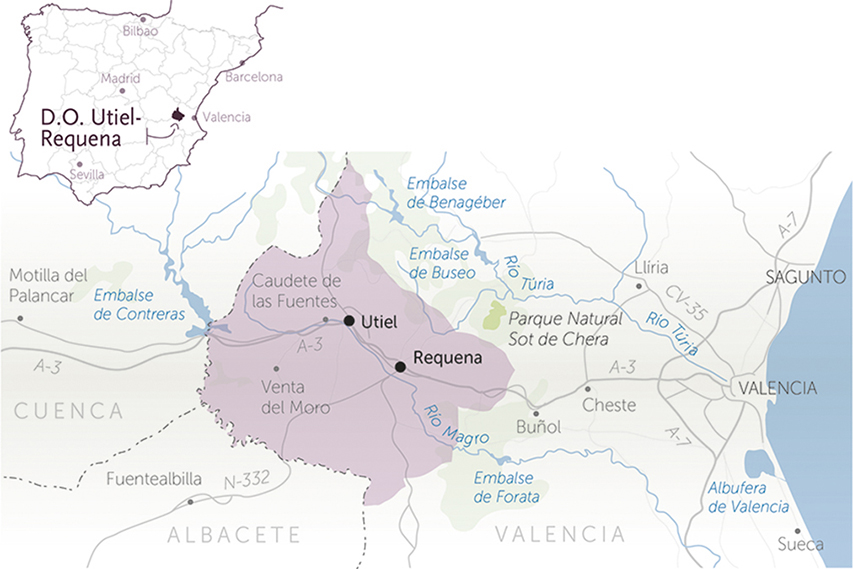
    If I were to ask a viticulturist to describe the perfect vineyard location, he’d paint a picture that sounds almost mythical: warm, sun drenched days; cool nights that preserve acidity; dry summers that keep disease at bay; winters cold enough to control pest populations and allow the vines a period of dormancy; cleansing winds that move through the vines like a daily reset; elevations high enough to deliver freshness, yet low enough to guarantee ripeness; and soils that drain beautifully while forcing the vine to work just hard enough. He’d describe a place where the growing season is long, the weather is reliable, and the grapes ripen slowly, evenly and with remarkable concentration. And then, once he finished describing this idealized landscape, I could tell him that such a place exists. And it’s less than an hour inland from Valencia.

    Welcome to DO Utiel Requena, one of Spain’s most quietly perfect winegrowing regions. Here, Mediterranean warmth meets continental cool. Vineyards sit between 600–900 meters of elevation, giving the region its signature diurnal shift: the secret behind the vibrant acidity, deep color and aromatic intensity of many of the region’s wines. Summer rainfall is almost nonexistent, allowing grapes to ripen under pristine skies. Winds sweep across the plateau, keeping the clusters dry and healthy. The soils — sandy loams and clay limestone mixes — are exactly what vines love: well drained, moderately fertile and deep enough to support old vines that have been producing characterful fruit for generations.

    In Utiel-Requena nature does most of the work. Viticulturists don’t have to fight the climate and winemakers don’t have to chase ripeness, it all happens as if part of a master plan. And don’t think Utiel-Requena is merely a good place to grow grapes. It’s a textbook example of how perfect conditions can translate into unforgettable wines. Which is why, given my love of wine, authenticity and landscapes shaped by centuries of viticultural tradition, this region rose to the top of my travel list.

    Lisa and I visited the region in February 2026. Winter had set in, a cold north wind blew and the vines were dormant. We had slightly less than a week to experience as much as possible, so our observations are limited and fractured. I look forward to many more visits to meet more winemakers, sample more restaurants, sleep in more beds and taste more wines. But here are a few first impressions:

    It is easy to find a very good bottle of wine.  In my opinion, the region produces Spain’s best sparkling wines.  And there are examples of Tardana and Merseguera, two native white grapes, that are very enjoyable. But the star of the show in Utiel-Requena is its native red grape, Bobal, some of which grows on very old vines.  You can find very inexpensive entry-level examples of Bobal-based wines, which tend to be ruby‑purple, juicy, mineral and wonderfully drinkable, the kind of wine poured in village bars and enjoyed without ceremony.  With a couple exceptions for very high-quality bottlings from top producers, even the best wines are relatively inexpensive.  Some of these top-of-the-house bottlings match (or exceed) more prestigious red wines from better-known regions in terms of color, body, structure and complexity.  These are old‑vine, high‑elevation Bobals that are dark, structured, powerful and built for aging.  These wines show just how far the grape can go when grown in the region’s best sites.  If you’re comparing and trying to pick a winner, the result will be based on the flavor of fruit you’re looking for.  If you just want to enjoy a very nice bottle of wine, look no further. 

    Enotourism is relatively new to the region.  There are several examples of charming and informative tours with a few glasses of exciting wines waiting at the end.  And there are some disappointments for those of us accustomed to the professional visits available in Napa Valley, for example.  The wineries that have not fully embraced enotourism seem to know it’s important but have failed to dedicate qualified personnel to manage it.  This is an understandable question of economics.  Vineyards are staffed to grow grapes and make wine and the question of bringing on more staff is not an easy one, especially in Spain’s highly regulated labor market and given that enotourism is a season and sporadic business in Utiel-Requena.  Many top wineries have found a way to offer limited enotourism options without increasing staffing, but they’re stretched too thin to do it well.  While it is possible that a cost-benefit analysis weighs against a robust investment in enotourism, it may be that they don’t yet appreciate the value of true hospitality. 

    You should expect a “rural hotel” to be rustic.  A rural hotel will often be in a spectacular location (like in the middle of a vineyard) and it may offer the best breakfast you’ve ever eaten (Pago de Tharsys), but it will not be the Ritz.  There is no Ritz in the Utiel-Requena region, but you can find comfortable lodging at very reasonable rates.  If you must have grand hotel accommodations, you may consider staying in Valencia and making the one-hour drive to wine country each day.

    Most of the restaurants we ate in were very good and fairly priced.  Wine lists typically offer a nice selection of local wines very gently marked-up.  For example, reliably good Las Ocho from Chozas Carrascal can be found in most restaurants at around €30,00; it’s available at the winery for €22,50.  Service quality tended to be very high and English was widely spoken.  We had only one negative dining experience and one roadside truck-stop lunch that met our expectations, which were low. 

    Now, I know I’ve told you a lot but given you little that is actionable.  So, here are a few specifics:

    • My favorite red wine was a 2019 Vino de Pago El Terrerazo Quincha Corral Bobal.  I can also recommend the 2016 Casa Don Angél Bobal and the 2020 Reserva (Bobal), both from Pago Vera de Estenas.  The best sparkling wines I tasted came from Pago de Tharysys (Millésime Brut Reserva) and Pago Chozas Carrascal (2017 Brut Nature Gran Reserva).  We did not have the opportunity to try the wines of Hispano Suiza, but I won’t miss them on our next trip.  Their Tantum Ergo Exclusive has been awarded the Best Cava in Spain for the last three years.
    • Our favorite winery was Pago Chozas Carrascal.  They excelled in every category from design and charm to hospitality to wine quality.  We could have stayed there all day.
    • Our favorite hotel room was at Finca Calderón, a winery, tasting room, wine bar/restaurant and culinary restaurant all rolled into one.
    • Our favorite restaurant in Requena was MERAKI and our favorite in Utiel was SANTOLINA.  

    We’ve got more to talk about regarding the Utiel-Requena region, most notably the fact that five of Spain’s 25 Pago estates are located there and what that means.   But I’ll save that for another day.

    Until next time, drink well.

  • Murcia’s Monastrell Triad

    Murcia’s Monastrell Triad

    There is a moment driving inland from the Mediterranean coast, when the landscape begins to shift. The sea breeze fades, the air grows drier and the horizon opens into a vast, sun‑baked interior where vineyards appear like brushstrokes across the earth. This is Murcia, one of Spain’s most quietly compelling wine territories, a region defined not by grand estates or centuries‑old fame, but by resilience, tradition and a single grape that has shaped its identity for millennia:  Monastrell (Mourvèdre in France, Mataro in other parts of the world).

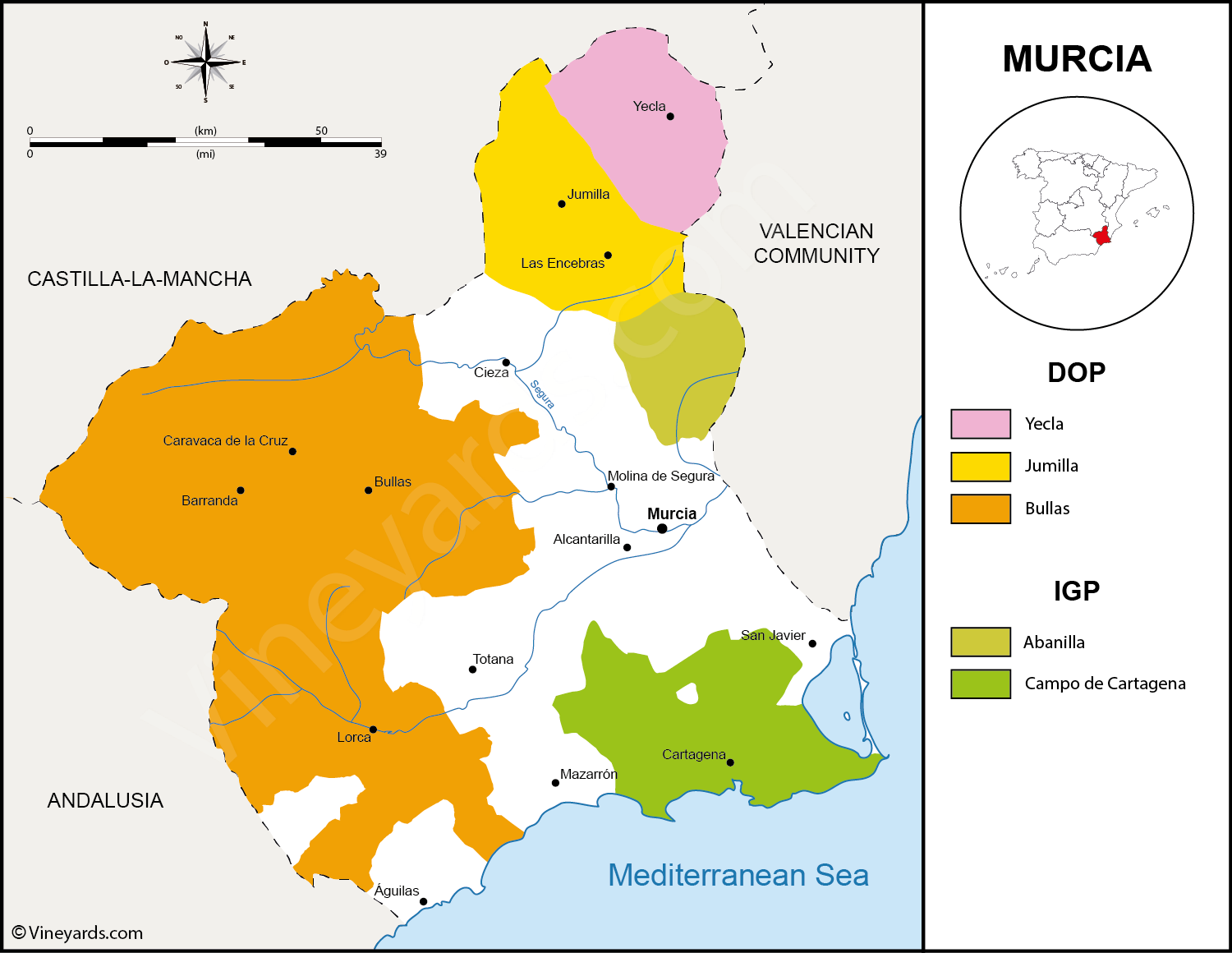
    Across three Denominaciones de Origen – Jumilla, Yecla and Bullas – Monastrell finds three distinct expressions, each shaped by altitude, soil, climate and the people who have tended these vines through droughts, frosts and the long arc of history. Together, these regions form a kind of vinous triangle, each point offering a different perspective on the same Mediterranean soul.

    In Jumilla, Monastrell speaks in a deep, resonant voice.  The wines are powerful, structured and sun‑drenched, shaped by broad plateaus and a climate of extremes.  It is the region that first carried Murcia’s wines onto the world stage, proving that old vines and modern vision could coexist with remarkable results.

    In Yecla, the grape becomes more architectural. The wines are precise, balanced and quietly expressive. Limestone soils and slightly cooler nights lend the wines a sense of focus, a tension between richness and restraint that has become the region’s signature.

    And in Bullas, high in the green, mountainous northwest, Monastrell takes on a fresher, more aromatic character. Here, altitude gives the wines their identity.  Cool nights, terraced vineyards and forest‑ringed valleys confer the wines with a brightness and lift that feel almost alpine.

    Three regions, one grape, infinite nuance.

    To explore Murcia through its wines is to understand how deeply place matters. How a shift in elevation, a change in soil or a different rhythm of harvest can transform a grape into something new. It is also to witness a region in motion, where tradition and innovation coexist, and where small family growers stand alongside ambitious modern wineries, all united by a shared respect for the land. This trilogy – Jumilla, Yecla, and Bullas – is an invitation to discover Murcia not as a single destination, but as a mosaic of landscapes and stories. Together, they reveal a region whose wines are as honest and expressive as the people who make them and whose future feels as promising as its ancient past.

    DO Jumilla

    Straddling the border between Murcia and Albacete, DO Jumilla is one of southeastern Spain’s most compelling wine regions, a landscape where ancient vines, extreme climate and a deep agricultural heritage converge to produce wines of striking power and authenticity. Larger and more widely recognized than its neighbors Yecla and Bullas, Jumilla has undergone a remarkable transformation over the past few decades, evolving from a bulk‑wine stronghold into a dynamic, quality‑driven appellation whose best bottles rival some of Spain’s most exciting Mediterranean reds.

    A History Forged in Fire and Survival

    Viticulture in Jumilla stretches back more than 2,000 years, with archaeological evidence of winemaking from the Iberians, Romans, and later the Moors, who left behind sophisticated irrigation systems that shaped the region’s agricultural identity. By the Middle Ages, Jumilla had become a thriving center of grape cultivation, and by the 19th century it was exporting wine across Spain and beyond.

    But the defining chapter in Jumilla’s modern history came with phylloxera, or rather, its absence. As in neighboring Yecla, Jumilla’s sandy, limestone‑rich soils proved inhospitable to the pest, allowing vast tracts of ungrafted, pre‑phylloxera Monastrell to survive well into the 20th century. This extraordinary stroke of luck preserved a genetic treasure trove of old vines, many of which still stand today as gnarled, low‑yielding monuments to the region’s past.

    Ironically, when phylloxera finally reached Jumilla in the late 1980s, it became a catalyst for renewal. The devastation forced growers to replant, modernize and rethink their approach to quality. The region’s official DO status, granted in 1966, provided a framework for this transformation, but it was the collective will of growers and winemakers that propelled Jumilla into a new era defined by precision, ambition and a renewed respect for its native grape.

    The Character of Jumilla: Monastrell at Full Volume

    If Yecla is the quiet power of Monastrell, Jumilla is its full‑throated expression. The grape accounts for roughly 70% of the DO’s plantings, thriving in a climate that is both harsh and ideal: scorching summers, frigid winters, and some of the lowest rainfall in Spain. Vineyards sit between 400 and 900 meters above sea level, where intense sunlight and dramatic diurnal shifts create grapes of exceptional concentration.

    Jumilla Monastrell is typically:

    • Deeply colored, often nearly opaque in youth
    • Aromatic, with black plum, blueberry, fig, and dried herbs
    • Structured, with firm tannins and a warm, generous palate
    • Savory, often showing hints of smoke, earth and Mediterranean scrub

    Modern winemaking has brought greater finesse to the region’s wines. While the traditional style was robust and rustic, today’s top producers craft Monastrell that is polished, balanced and capable of long aging. Blends incorporating Syrah, Garnacha Tintorera, Cabernet Sauvignon and Petit Verdot add further dimension, while whites from Airén, Macabeo and increasingly, Verdejo offer refreshing counterpoints.

    Viticulture and Viniculture: Tradition Meets Precision

    Jumilla’s vineyards are dominated by dry‑farmed, bush‑trained vines, many of them decades old. The region’s poor, stony soils – limestone, sand, and clay – force the vines to struggle, resulting in naturally low yields and remarkable concentration.

    Key viticultural hallmarks include:

    • Dry farming, which is essential in this arid region, where deep‑rooted Monastrell vines and limestone soils are perfectly adapted to less than 300 mm of annual rainfall
    • Old vines, including rare, ungrafted (pie franco) parcels
    • Organic practices, increasingly common due to the dry climate’s natural resistance to disease
    • High‑altitude sites, which preserve acidity and aromatic lift

    In the cellar, Jumilla winemakers blend tradition with innovation. Stainless steel fermentation is standard, but many producers also experiment with:

    • Concrete tanks, prized for their gentle oxygen exchange
    • Large foudres and neutral oak, which add texture without overwhelming the fruit
    • Amphorae, a nod to ancient Iberian winemaking

    The People Behind the Wines: Visionaries and Standard‑Bearers

    Jumilla’s rise is inseparable from the individuals and families who championed its potential. Three wineries, in particular, have shaped the region’s modern identity.

    Bodegas Juan Gil: The Modern Icon

    No name is more synonymous with Jumilla’s global reputation than Bodegas Juan Gil. Founded in 1916 and now led by the fourth generation, the Gil family transformed the region’s image through a relentless focus on quality and a deep respect for old‑vine Monastrell. Their flagship wine, Juan Gil Silver Label, became an international benchmark, rich, polished, and unmistakably Mediterranean. The family’s investment in high‑altitude vineyards, sustainable farming and state‑of‑the‑art facilities has made them ambassadors for Jumilla on the world stage.

    Casa Castillo: The Purist’s Reference Point

    If Juan Gil represents modern power, Casa Castillo embodies elegance and terroir. Founded in 1941 on an old estate originally planted by French immigrants fleeing phylloxera, the winery is now helmed by José María Vicente, one of Spain’s most respected winemakers. Vicente’s philosophy is rooted in restraint: minimal intervention, careful extraction, and a profound respect for the land. Wines like Casa Castillo Pie Franco, made from ungrafted Monastrell, are considered among the greatest Mediterranean reds in Spain:  complex, mineral and hauntingly expressive.

    Bodegas El Nido: The Cult Sensation

    A collaboration between the Gil family and Australian winemaker Chris Ringland, Bodegas El Nido burst onto the scene in the early 2000s with a bold, opulent style that captivated critics. Their top wine, El Nido, blends Monastrell with Cabernet Sauvignon to create a dense, luxurious red that helped redefine what Jumilla could achieve. While stylistically different from Casa Castillo’s restraint, El Nido’s success proved the region’s versatility and its ability to produce world‑class wines across a spectrum of styles.

    A Region in Full Stride

    From ancient, ungrafted vines to cutting‑edge cellars, DO Jumilla is a region that has embraced its past while boldly stepping into the future. Its wines offer a vivid expression of southeastern Spain’s rugged beauty and agricultural heritage. For wine lovers seeking authenticity, depth and a sense of place, Jumilla delivers in every glass. It is a region that rewards exploration, celebrates resilience and continues to evolve.  One powerful, expressive bottle at a time.

    DO Yecla

    Tucked away in the northern reaches of Spain’s Murcia region, DO Yecla is a wine territory that, while smaller in scale than some of its neighbors, punches well above its weight in terms of quality and character. With a history deeply intertwined with its star grape, Monastrell, Yecla offers a compelling blend of tradition and innovation, producing wines of remarkable depth and authenticity.

    A Legacy Rooted in Ancient Vines

    Yecla’s winemaking heritage is ancient, with evidence of viticulture stretching back to the Phoenicians and Romans. The region’s strategic location and fertile plains made it an important agricultural center throughout history. By the 16th century, under the reign of Felipe II, Yecla was formally recognized as a “Bodega Mayor,” a major wine-producing area. When phylloxera swept through Europe in the late 19th and early 20th centuries, Yecla, like its neighbor Jumilla, was uniquely positioned. Many of its vineyards, particularly those on sandy, limestone-rich soils, exhibited a natural resistance to the pest, allowing a significant number of old, ungrafted Monastrell vines to survive. This remarkable survival meant that Yecla has maintained a precious genetic diversity and a living link to its past. The region officially achieved its DO status in 1975, a crucial step in formalizing quality standards and promoting its unique identity.

    The Heart of Yecla: Monastrell and its Expression

    Monastrell is undeniably the soul of Yecla. It accounts for approximately 85% of the DO’s vineyard plantings. This sturdy, late-ripening grape thrives in Yecla’s challenging Mediterranean-continental climate, characterized by hot, dry summers, cold winters and extreme diurnal temperature shifts. This climate, coupled with low rainfall (around 300 mm annually), stresses the vines, forcing them to produce concentrated, flavorful grapes.

    Yecla Monastrell is typically:

    • Deeply colored, showing an intense purplish‑cherry hue
    • Richly aromatic, with blackberry, plum, and black cherry layered over balsamic notes, spice, Mediterranean herbs and occasional hints of earth or graphite
    • Full‑bodied and warm, with generous fruit, excellent extract and firm yet often smooth tannins
    • Structured and age-worthy, with modern styles favoring complex, barrel‑aged expressions that mature gracefully over several years

    Beyond Monastrell, other red varieties like Garnacha Tinta, Syrah, Tempranillo, Merlot and Cabernet Sauvignon are also cultivated, often used in blends to add layers of complexity. Five percent (5%) of the region is planted to white grapes, primarily Macabeo (Viura), Airén, Chardonnay and Sauvignon Blanc.

    Viticulture and Viniculture: A Dance with Nature

    Yecla’s vineyards are situated at altitudes ranging from 400 to 800 meters above sea level. The soils are predominantly limestone, with a sandy surface and clay formations, offering good drainage and excellent water retention deep within the subsoil, which is vital in this arid climate. Many older vineyards are still dry-farmed and trained as bush vines (gobelet), a traditional method that protects the grapes from direct sun and helps conserve precious moisture. The focus is always on low yields to ensure optimal concentration and ripeness in the grapes.

    In the cellar, Yecla winemakers embrace both modern technology and time-honored techniques. Stainless steel tanks are used for fermentation, allowing for precise temperature control to preserve the delicate fruit characteristics of Monastrell. A significant portion of the red wines undergoes aging in oak barrels, typically French and American, which contributes to their structure, complexity, and aromatic profile, adding notes of vanilla, toast, and subtle spice. There’s a growing emphasis on balance in oak use, allowing the varietal character of Monastrell to shine through rather than being overshadowed.

    Leading Lights and Illustrious Wineries

    Yecla’s emergence on the global wine scene is due in no small part to the dedication and vision of key families and wineries who have championed the region’s potential.

    Bodegas Castaño

    One of the most prominent families, and central to Yecla’s modern success, is the Castaño family of Bodegas Castaño. With a history dating back to 1950, Ramón Castaño Santa was a true pioneer, modernizing winemaking practices and advocating for the Monastrell grape when many were still focused on bulk production. Today, the fourth generation continues his legacy, producing a wide range of wines from everyday values to critically acclaimed single-vineyard expressions. Their Hécula Monastrell has become an iconic wine for the region, showcasing the grape’s power and elegance. The Castaños have been instrumental in elevating Yecla’s image and demonstrating the quality potential of Monastrell.

    Bodegas Trenza

    Another influential force in modern Yecla is Bodegas Trenza, a boutique project founded by the Danish‑born Ponce brothers, David and Jonas, who fell in love with the region’s old‑vine Monastrell. Trenza has become known for its meticulous vineyard selection, working with some of Yecla’s highest‑quality parcels, many of them dry‑farmed, bush‑trained and rooted in the area’s signature limestone soils. Their philosophy blends Scandinavian precision with Mediterranean warmth, resulting in wines that emphasize purity, balance and textural finesse. While their portfolio includes expressive blends, it is their nuanced, site‑driven Monastrell that has helped elevate Yecla’s reputation on the international stage, proving that the region can produce wines of both power and elegance.

    De Naríz

    Equally noteworthy is De Naríz, a small but ambitious winery led by winemaker Pablo Calatayud, whose work has brought fresh energy and artisanal focus to Yecla’s landscape. De Naríz champions low‑intervention viticulture and careful, small‑lot vinification, often highlighting old vines from cooler, higher‑altitude zones where Monastrell develops remarkable aromatic lift. The winery’s approach is rooted in respect for tradition – manual harvesting, restrained oak, and an emphasis on expressing the natural character of the grape – yet the wines feel distinctly contemporary in their precision and vibrancy. De Naríz has quickly earned a reputation for crafting some of Yecla’s most refined and expressive Monastrells, reinforcing the region’s growing identity as a source of thoughtful, terroir‑driven Mediterranean reds.

    Bodegas La Purísma

    Another significant player is Bodegas La Purísima, one of Spain’s largest and most respected cooperatives. Established in 1946, La Purísima plays a crucial role in the Yecla wine landscape, representing a large number of local grape growers. While historically associated with bulk wine, in recent decades, they have made substantial investments in modernizing their facilities and focusing on quality, producing a diverse portfolio of wines, including award-winning organic options. Their commitment to the region and its growers is a testament to the cooperative spirit.

    A Region Hitting Its Stride

    From ancient vines to modern winemaking, Yecla continues to write its story, one powerful, expressive glass of Monastrell at a time. It’s a region that rewards exploration, offering genuine character and a true taste of southeastern Spain’s vinous heartland.

    DO Bullas

    Tucked into the northwest corner of Murcia, DO Bullas is the most softly spoken of the region’s three Monastrell appellations, but its quietness is deceptive. Here, in a landscape of pine forests, terraced vineyards, and cool mountain air, Monastrell takes on a distinctly different voice: fresher, more aromatic, shaped by altitude and a long tradition of small‑scale, family‑run viticulture. If Jumilla is power and Yecla is precision, Bullas is purity, a region where the grape’s Mediterranean soul meets the freshness of Spain’s interior highlands.

    A History Rooted in Mountain Agriculture

    Bullas has been a winegrowing territory for millennia. Archaeological remains – Roman amphorae, Iberian pottery, and ancient presses – attest to a long, continuous relationship with the vine. But unlike Jumilla and Yecla, whose histories were shaped by large‑scale commerce, Bullas developed as a mountain farming culture, where vineyards were part of a diversified agricultural mosaic.

    By the Middle Ages, Bullas was known for its terraced vineyards and small cellars carved into hillsides. The region’s relative isolation preserved traditional practices well into the 20th century. When phylloxera devastated Europe, Bullas suffered less than many regions thanks to its altitude and sandy soils, allowing pockets of old Monastrell to survive.

    The DO was officially recognized in 1994, making it the youngest of Murcia’s appellations. Yet its identity – high‑altitude Monastrell grown in a cooler, greener landscape – has deep roots.

    A History Rooted in Mountain Agriculture

    Bullas sits between 500 and 900 meters above sea level, making it the highest of Murcia’s three Monastrell DOs. This altitude is the key to its style.

    Bullas Monastrell is typically:

    • Brightly colored, with a vivid cherry‑purple hue
    • Aromatic, offering red fruit – raspberry, cherry, pomegranate – alongside wild herbs and floral notes
    • Fresh and balanced, with natural acidity that sets it apart from the warmer styles of Jumilla
    • Medium‑bodied, with fine tannins and a clean, mineral finish

    The wines feel lifted, almost alpine in their clarity, shaped by cool nights and slower ripening. While Bullas can produce powerful reds, its signature is elegance.

    White wines, particularly from Macabeo, also shine here, offering crispness and subtle stone‑fruit character. Rosés, long a local specialty, are vibrant and refreshing.

    Viticulture and Viniculture: A Landscape of Terraces and Tradition

    Bullas is one of the most visually striking vineyard regions in southeastern Spain. Vineyards cling to slopes, sit in small valleys or stretch across high plateaus surrounded by forests. The soils – limestone, clay, and sand – vary dramatically with altitude and exposure.

    Viticulture here is defined by:

    • High‑altitude bush vines, many of them old and dry‑farmed
    • Terraced vineyards, a legacy of centuries of mountain agriculture
    • Organic practices, increasingly common due to the region’s clean air and low disease pressure
    • Low yields, essential for concentration in this cooler climate

    In the cellar, winemakers emphasize freshness and purity. Stainless steel is widely used, and oak aging tends to be more restrained than in Jumilla or Yecla. Some producers are experimenting with concrete and amphorae to highlight the grape’s natural brightness.

    The overarching philosophy is simple: let the altitude speak.

    The People and Wineries Shaping Bullas Today

    Bullas may be small, but it is home to a passionate community of growers and winemakers who have championed quality and identity. Three wineries, in particular, illustrate the region’s diversity and potential.

    Bodegas Lavia: Precision at Altitude

    Founded in the early 2000s and now part of the MG Wines Group, Bodegas Lavia has become one of Bullas’ most respected producers. Their vineyards sit at 800–900 meters, among the highest in the DO, and are farmed organically.

    Lavia’s wines are defined by finesse: Monastrell with lifted aromatics, fine tannins and a mineral backbone. Their flagship bottlings – often sourced from old vines in the Venta del Pino area – show how altitude can transform the grape into something almost Burgundian in its elegance.

    Bodegas Balcona (Viña La Sierra): A Family’s Mountain Legacy

    In the valley of Aceniche, one of the DO’s coolest and most beautiful subzones, Bodegas Balcona stands as a testament to family dedication. Founded by the Vicente family, the winery farms old‑vine Monastrell surrounded by pine forests and almond groves.

    Their iconic wine, “Matusalén,” comes from century‑old vines that produce tiny yields of intensely aromatic fruit. Balcona’s style is both traditional and expressive: wines that feel deeply connected to the land, shaped by altitude, patience and a quiet respect for nature.

    Bodega Monastrell: Tradition with a Modern Touch

    Located near the town of Bullas itself, Bodega Monastrell blends heritage with contemporary winemaking. The winery works with growers across the DO, focusing on old bush vines planted in limestone soils.

    Their wines are approachable yet serious, offering classic Bullas freshness with just enough structure to age gracefully. The emphasis is always on purity: clean, vibrant Monastrell that captures the region’s mountain character.

    A Region Coming into Its Own

    Bullas may not have the international recognition of Jumilla or the rising star power of Yecla, but that is part of its charm. It is a region of quiet confidence, where altitude, tradition and a cooler climate give Monastrell a voice unlike anywhere else in Spain.

    For travelers and wine lovers seeking authenticity, beauty, and a fresh perspective on Murcia’s signature grape, Bullas offers a compelling, high‑altitude counterpoint – a place where the Mediterranean meets the mountains, and where every glass carries the imprint of clean air, old vines and the steady patience of those who farm them.

    DO Alicante

    For any lover of Spanish Monastrell, it is worth noting that some subzones of DO Alicante, which is located in neighboring autonomous region of Comunidad Valencia but is separated from DO Yecla by nothing more than a political border, also produce excellent Monastrell. These inland subzones occupy the hot, arid interior valleys of Vinalopó and share much with their Murcian neighbor with vineyards at 400–700 meters, limestone‑rich, alluvial soils and very low rainfall, creating ideal conditions for Monastrell. The combination of intense summer heat, marked diurnal shifts and old, dry‑farmed bush vines produces deeply structured reds with concentrated fruit and savory Mediterranean notes. Historically, Alicante was a major exporter of fondillón, a naturally sweet, oxidative Monastrell wine that once rivaled Madeira and Port.