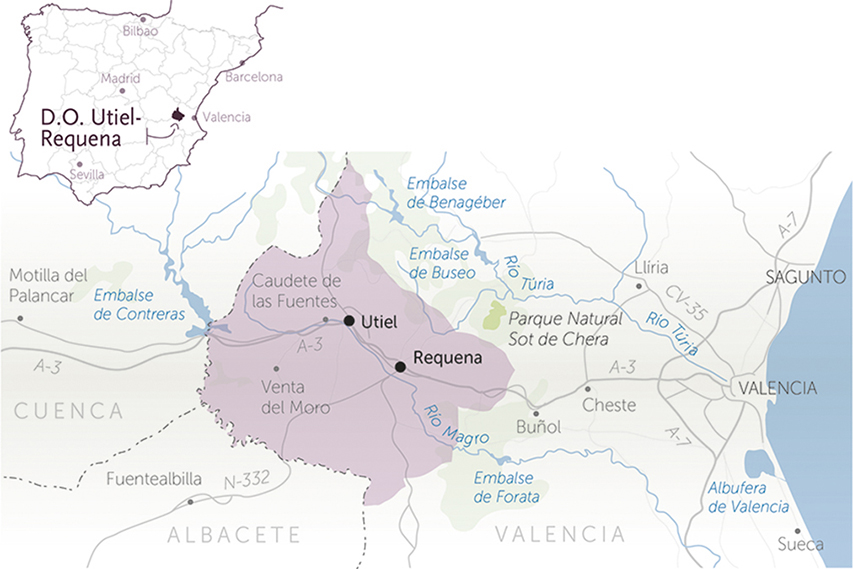
If I were to ask a viticulturist to describe the perfect vineyard location, he’d paint a picture that sounds almost mythical: warm, sun drenched days; cool nights that preserve acidity; dry summers that keep disease at bay; winters cold enough to control pest populations and allow the vines a period of dormancy; cleansing winds that move through the vines like a daily reset; elevations high enough to deliver freshness, yet low enough to guarantee ripeness; and soils that drain beautifully while forcing the vine to work just hard enough. He’d describe a place where the growing season is long, the weather is reliable, and the grapes ripen slowly, evenly and with remarkable concentration. And then, once he finished describing this idealized landscape, I could tell him that such a place exists. And it’s less than an hour inland from Valencia.
Welcome to DO Utiel Requena, one of Spain’s most quietly perfect winegrowing regions. Here, Mediterranean warmth meets continental cool. Vineyards sit between 600–900 meters of elevation, giving the region its signature diurnal shift: the secret behind the vibrant acidity, deep color and aromatic intensity of many of the region’s wines. Summer rainfall is almost nonexistent, allowing grapes to ripen under pristine skies. Winds sweep across the plateau, keeping the clusters dry and healthy. The soils — sandy loams and clay limestone mixes — are exactly what vines love: well drained, moderately fertile and deep enough to support old vines that have been producing characterful fruit for generations.
In Utiel-Requena nature does most of the work. Viticulturists don’t have to fight the climate and winemakers don’t have to chase ripeness, it all happens as if part of a master plan. And don’t think Utiel-Requena is merely a good place to grow grapes. It’s a textbook example of how perfect conditions can translate into unforgettable wines. Which is why, given my love of wine, authenticity and landscapes shaped by centuries of viticultural tradition, this region rose to the top of my travel list.
Lisa and I visited the region in February 2026. Winter had set in, a cold north wind blew and the vines were dormant. We had slightly less than a week to experience as much as possible, so our observations are limited and fractured. I look forward to many more visits to meet more winemakers, sample more restaurants, sleep in more beds and taste more wines. But here are a few first impressions:
It is easy to find a very good bottle of wine. In my opinion, the region produces Spain’s best sparkling wines. And there are examples of Tardana and Merseguera, two native white grapes, that are very enjoyable. But the star of the show in Utiel-Requena is its native red grape, Bobal, some of which grows on very old vines. You can find very inexpensive entry-level examples of Bobal-based wines, which tend to be ruby‑purple, juicy, mineral and wonderfully drinkable, the kind of wine poured in village bars and enjoyed without ceremony. With a couple exceptions for very high-quality bottlings from top producers, even the best wines are relatively inexpensive. Some of these top-of-the-house bottlings match (or exceed) more prestigious red wines from better-known regions in terms of color, body, structure and complexity. These are old‑vine, high‑elevation Bobals that are dark, structured, powerful and built for aging. These wines show just how far the grape can go when grown in the region’s best sites. If you’re comparing and trying to pick a winner, the result will be based on the flavor of fruit you’re looking for. If you just want to enjoy a very nice bottle of wine, look no further.
Enotourism is relatively new to the region. There are several examples of charming and informative tours with a few glasses of exciting wines waiting at the end. And there are some disappointments for those of us accustomed to the professional visits available in Napa Valley, for example. The wineries that have not fully embraced enotourism seem to know it’s important but have failed to dedicate qualified personnel to manage it. This is an understandable question of economics. Vineyards are staffed to grow grapes and make wine and the question of bringing on more staff is not an easy one, especially in Spain’s highly regulated labor market and given that enotourism is a season and sporadic business in Utiel-Requena. Many top wineries have found a way to offer limited enotourism options without increasing staffing, but they’re stretched too thin to do it well. While it is possible that a cost-benefit analysis weighs against a robust investment in enotourism, it may be that they don’t yet appreciate the value of true hospitality.
You should expect a “rural hotel” to be rustic. A rural hotel will often be in a spectacular location (like in the middle of a vineyard) and it may offer the best breakfast you’ve ever eaten (Pago de Tharsys), but it will not be the Ritz. There is no Ritz in the Utiel-Requena region, but you can find comfortable lodging at very reasonable rates. If you must have grand hotel accommodations, you may consider staying in Valencia and making the one-hour drive to wine country each day.
Most of the restaurants we ate in were very good and fairly priced. Wine lists typically offer a nice selection of local wines very gently marked-up. For example, reliably good Las Ocho from Chozas Carrascal can be found in most restaurants at around €30,00; it’s available at the winery for €22,50. Service quality tended to be very high and English was widely spoken. We had only one negative dining experience and one roadside truck-stop lunch that met our expectations, which were low.
Now, I know I’ve told you a lot but given you little that is actionable. So, here are a few specifics:
- My favorite red wine was a 2019 Vino de Pago El Terrerazo Quincha Corral Bobal. I can also recommend the 2016 Casa Don Angél Bobal and the 2020 Reserva (Bobal), both from Pago Vera de Estenas. The best sparkling wines I tasted came from Pago de Tharysys (Millésime Brut Reserva) and Pago Chozas Carrascal (2017 Brut Nature Gran Reserva). We did not have the opportunity to try the wines of Hispano Suiza, but I won’t miss them on our next trip. Their Tantum Ergo Exclusive has been awarded the Best Cava in Spain for the last three years.
- Our favorite winery was Pago Chozas Carrascal. They excelled in every category from design and charm to hospitality to wine quality. We could have stayed there all day.
- Our favorite hotel room was at Finca Calderón, a winery, tasting room, wine bar/restaurant and culinary restaurant all rolled into one.
- Our favorite restaurant in Requena was MERAKI and our favorite in Utiel was SANTOLINA.
We’ve got more to talk about regarding the Utiel-Requena region, most notably the fact that five of Spain’s 25 Pago estates are located there and what that means. But I’ll save that for another day.
Until next time, drink well.